Summary: This article reviews common claims about urban trees and compares them with current urban forestry research. Topics include replacement planting, mature tree value, biodiversity, and the ecological role of urban forests in climate resilience.
By 🐿️ Squirrel for Mayor
What does the urban forest have to do with housing myths?
That is a fair question—one worth directing to the registered third-party advertising (housing advocacy organization) group Homes for Living and its webpage, Housing Myths: Common Anti-Housing Misconceptions and Myths.
Homes for Living is active throughout the Capital Regional District and regularly participates in public discussions about housing, land use, and municipal policy. On its website, the organization presents a series of “myth-busting” statements intended to challenge what it considers common misconceptions about housing and development.
One of those myths is titled:
“Densification will lead to the removal of urban trees.”
Urban trees, biodiversity, and the Garry oak ecosystem are increasingly being drawn into housing debates. Concerns about tree loss are often characterized as barriers to housing, while advocates for stronger urban forest protection are sometimes dismissed as opponents of growth.
The purpose of this article is not to argue against housing. Rather, it is to examine the assumptions underlying Homes for Living’s claims about trees, urban forests, and ecological conservation, and to compare those claims with current policy, ecological science, and on-the-ground conditions in Victoria.
Let’s begin with Homes for Living entire statement on the urban forest:
Housing Myths: Common Anti-Housing Misconceptions and Myths. by Homes for Living
🌳 Densification will lead to the removal of urban trees
We can all agree that trees beautify our city and we want to have them on our streets, boulevards, and yards. However if you look at the most beautiful and established neighbourhoods in Victoria, those are not original old-growth trees and most are not native. The original trees on those sites were all cut down when the houses were built, but we planted new ones that we can enjoy today. We can ensure that the same happens for infill development. Preserving all trees is not possible, but ensuring that at least as many are planted as are removed can be done and is consistent with how all the other houses in Victoria were built.
We also need to consider that the question is not to cut or not cut trees. People will live somewhere, and if they cannot live in denser housing in the city, they will be pushed out to the suburbs where real forests which form habitats for many more species are clear-cut for sprawling single family developments. Therefore, the best way to preserve trees is to allow denser development.
Most municipalities also have tree protection bylaws and developments plant new trees on or off site to compensate for trees cut to build. For example, despite development, Victoria’s urban forest is actually growing.
Squirrel for Mayor Myth-Busting
1. “We can all agree that trees beautify our city and we want to have them on our streets, boulevards, and yards.”
🐿️ Squirrel for Mayor
This immediately frames trees as aesthetic amenities, not ecological infrastructure, cooling systems, floodwater mitigation, habitat networks, carbon storage systems, or living cultural artifacts.
Trees are reduced to beautification and treated as replaceable. This echoes City of Victoria Councillor Matt Dell’s comparison of the Garry oak ecosystem to fruit-tree monocultures in the Okanagan.
The framing reveals that trees are valued for how they look rather than for what they do. Yet urban forests are increasingly recognized as essential municipal infrastructure that provides measurable economic, ecological, and public health benefits.
2. “However if you look at the most beautiful and established neighbourhoods in Victoria, those are not original old-growth trees and most are not native.”
🐿️ Squirrel for Mayor
Up to 75% of the urban forest is located on private property. There is no comprehensive dataset that identifies the species, age, or condition of trees at that scale—such as a full inventory of Garry oak trees across private lands, in the Capital Regional District.
Without that level of data, claims about what is “mostly native” or “not old-growth” are speculative rather than evidence-based.
We know from urban forest professionals and arborists who use increment bore tools that there are old-growth and veteran trees throughout the region. Many neighbourhoods contain mature Garry oaks that predate European settlement, some estimated to be 300 to 500 years old.
The argument that “most are not native” or that a degraded ecosystem no longer merits protection because it has already been substantially altered is a familiar one. We often hear that because only a small fraction remains, restoration is impractical, preservation is unnecessary, or replacement with something else is sufficient.
Yet Indigenous groups and conservation biology reach the opposite conclusion. The rarer an ecosystem becomes, the more valuable its remaining fragments become.
3. “The original trees on those sites were all cut down when the houses were built, but we planted new ones that we can enjoy today.”
🐿️ Squirrel for Mayor
This is a historical normalization argument that is void of historical rigour: It happened before, so it’s acceptable now. This suggests that because environmental colonialism is ongoing, it gives urbanists permission to imagine a future that doesn’t require restitution, repair, or recovery.
This framing ignores the well-documented presence of old-growth Garry oak trees on private property across the Capital Regional District. It downplays the value of existing urban canopy by suggesting it is already degraded or inauthentic.
Many established Garry oaks are hundreds of years old. Some trees are estimated to be more than 500 years old. Even stunted trees growing on rocky outcrops around the Mount Tolmie area can be hundreds of years old
Historical evidence often points in the opposite direction. Early development frequently worked around Garry oak landscapes. The Uplands in Oak Bay, for example, was intentionally designed with winding roads and irregular lot patterns to preserve the existing Garry oak savannah.
The lesson from history is not that trees were always removed. In many cases, the lesson is that people found ways to build while retaining them.
4. “We can ensure that the same thing happens for infill development.”
🐿️ Squirrel for Mayor
The claim that “the same thing can happen for infill development” overlooks how current regulations operate in practice.
Provincial housing legislation and local zoning changes have significantly reduced the flexibility available to retain existing trees on redevelopment sites. Once a proposed building envelope is established, any tree within that footprint can be considered a candidate for removal, regardless of its size, age, or ecological value.
In the City of Victoria, amendments to the 2050 Official Community Plan reduced the minimum contiguous plantable space requirement on most development sites from 9% to 6%.
This makes it increasingly difficult to accommodate replacement trees, particularly large-canopy species that require substantial soil volume and rooting space to reach maturity.
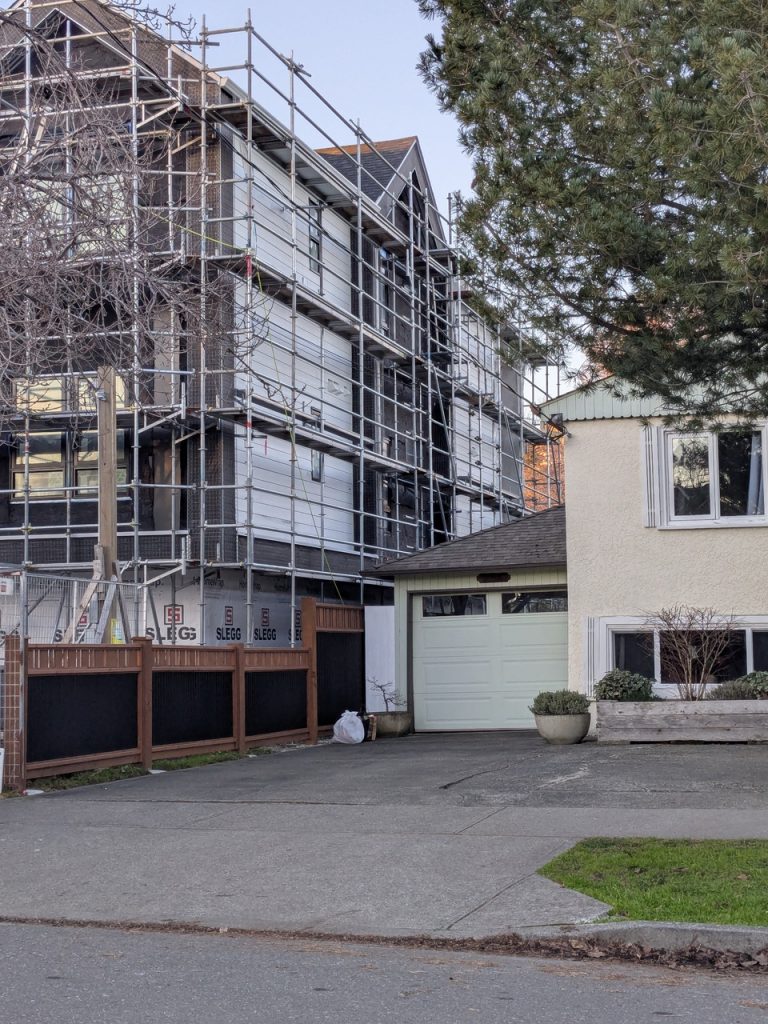
The challenge is visible on many newly developed properties. A six-metre rear-yard setback, for example, provides limited opportunity to retain large existing trees while accommodating buildings, servicing, access requirements, and landscaping. At the same time, meeting the Minimum Required Trees Per Lot standard can be difficult when Tree Protection Bylaw spacing requirements are applied.
As a result, the assumption that removed trees can simply be replaced does not reflect the physical realities of contemporary development sites.
5. “Preserving all trees is not possible, but ensuring that at least as many are planted as are removed can be done.”
🐿️ Squirrel for Mayor
The statement ignores space constraints.
Developments that remove trees from private property can either plant replacement trees on site or pay a cash-in-lieu contribution to the Tree Reserve Fund. In practice, many developments opt for the latter because the available planting space is insufficient to meet replacement requirements. Plus, paying 1:1 ($2000 per tree) is cheaper than using the land for a larger building, then replacement on-site at 3:1.
As development density increases and contiguous plantable space requirements shrink, there is often not enough soil volume or rooting space to support replacement trees at maturity.
A site that once supported several large canopy trees may only have room for a handful of ornamental trees after redevelopment.
The problem is compounded by geography. Victoria is a physically constrained municipality with limited opportunities for new public parks and limited space for future canopy expansion.
The objective should not simply be to replace tree numbers. It should be to retain mature trees wherever possible and design development around irreplaceable natural assets.
6. “We also need to consider that the question is not to cut or not cut trees. People will live somewhere, and if they cannot live in denser housing in the city, they will be pushed out to the suburbs where real forests which form habitats for many more species are clear-cut for sprawling single family developments. Therefore, the best way to preserve trees is to allow denser development.“
🐿️ Squirrel for Mayor
At first glance, this argument seems reasonable: build where people already live and protect forests elsewhere.
The problem is that it assumes ecosystems are interchangeable.
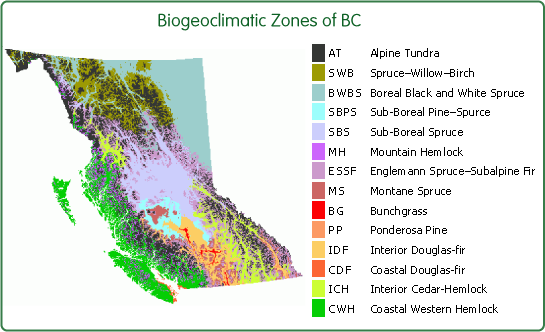
The Capital Regional District lies within the Coastal Douglas-fir Moist Maritime Biogeoclimatic Zone—the smallest and most endangered ecological zone in British Columbia and one of the most imperilled in Canada.
By contrast, much of the West Shore falls within the Coastal Western Hemlock (CWH) zone—a different ecological system altogether, with vastly greater extent and resilience.
Both systems are under pressure. But they are not interchangeable, and they are not equally at risk.
Removing a Garry oak ecosystem in Victoria does not “save” a Coastal Western Hemlock forest in Metchosin. It simply removes a rare ecosystem from Victoria.
There is also little evidence that densification in one municipality directly prevents ecological loss in another. Development patterns are shaped by economics, policy, land ownership, infrastructure, and consumer preferences—not by a simple one-for-one substitution effect.
More importantly, the argument ignores ecological specificity. In the CRD, Garry oak ecosystems only ever existed east of Langford Lake and Goldstream: Victoria, Saanich, Oak Bay, Esquimalt, View Royal, Colwood (Olympic Mountain rain shadow).
The argument that “people will simply move farther out” also assumes Greater Victoria has an unlimited supply of developable land beyond Langford.
It does not.
The region is constrained by geography, topography, protected parklands, watersheds, agricultural lands, First Nations territories, and the Pacific Ocean. Much of the land west and north of Langford is environmentally sensitive, difficult to service, protected, or unsuitable for large-scale urban expansion.
The question is not whether growth will occur.
The question is whether growth will be designed around the ecological realities of place.
7. “Despite development, Victoria’s urban forest is actually growing.”
🐿️ Squirrel for Mayor
Tree protection bylaws were effectively rendered moot by Bill 44. Any tree can be removed if it falls within a proposed building envelope. At the same time, replacement strategies are increasingly failing because development setbacks are often too small to accommodate large-canopy trees at maturity.
Most developments cannot realistically achieve the required 3:1 tree replacement ratio. Instead, developers pay a 1:1 cash-in-lieu fee, with the expectation that removed trees will be replaced on public land. This shifts the canopy from neighbourhoods—where trees provide the greatest benefits for urban cooling, stormwater management, and livability—to parks, where canopy is already concentrated. The result is often a net loss of ecological function at the neighbourhood level.
The consequences are already visible.
Victoria’s canopy did increase by the equivalent of 100 soccer fields between 2013 and 2023 while adding more than 8,000 net new homes. However, between 2019 and 2023, canopy growth fell 23 hectares short of the pace achieved during the previous four-year period—a decline of roughly 50% in the growth rate.
Housing growth is already placing measurable pressure on the urban forest.
One reason is that many new developments cannot meet on-site tree replacement requirements on increasingly constrained sites with larger building footprints and instead rely on cash-in-lieu payments. Recent FOI results show that cash-in-lieu funds have ballooned, with money spent on items like business cards and work boots, even though the funds are specifically for tree planting.
If that trend continues, canopy gains will slow further and could eventually reach a point of stagnation or net loss.
Notably, B.C.’s housing strategy contains little discussion of urban forests, biodiversity, greenspace, or urban cooling. Incorporating tree canopy and climate resilience objectives into housing policy will require strong support from local governments and elected officials committed to building climate-ready communities.
Conclusion
The urban forest is not anti-housing.
Perhaps the most persistent myth is the idea that Garry oak ecosystems are somehow less worthy of protection because they do not look like what many people imagine a “real forest” to be. A Garry oak meadow, savannah, or woodland can appear open, fragmented, or heavily altered by urbanization. Yet these landscapes represent one of the most endangered ecosystems in Canada, supporting more than 1,645 co-evolved species and thousands of years of ecological and cultural history.
When housing advocates argue that protecting urban trees merely shifts development pressure to “real forests” elsewhere, they overlook a fundamental reality: Garry oak ecosystems are real forests. They are real ecosystems. They are real habitat. And they exist nowhere else in Canada except a small portion of southeastern Vancouver Island and the Gulf Islands.
The question is not whether housing should be built. The question is whether we are willing to recognize the ecological value of the landscapes that remain and design communities that accommodate both people and nature.
If we continue treating Garry oak ecosystems as expendable because they do not conform to popular images of a forest, we risk losing one of the most unique and imperilled ecological communities in the country—not because we lack the knowledge to protect it, but because we refuse to recognize its value.