By 🐿 Squirrel for Mayor
The proposed development at 903 Admirals Road has become a test case for how municipalities can use new powers under British Columbia’s housing legislation to require stronger environmental performance from development projects.
At the centre of the discussion is Bill 16 (Housing Statutes Amendment Act, 2024), which expanded municipal authority under the Local Government Act to require sustainable design features, climate resilience measures, and other site-level infrastructure through servicing bylaws.
Key Meeting with Engineering Staff
On May 29, 2026, representatives from the Esquimalt Climate Organizers (ECO) met with Esquimalt’s Director of Engineering and Public Works and Servicing Officer, Joel Clary, to discuss how Bill 16 could be applied in Esquimalt.
Several important points emerged:
- Bill 16 does not automatically create new requirements. Municipalities must adopt bylaws before a Servicing Officer can enforce them.
- Existing servicing bylaws already allow some environmental requirements, such as limiting post-development stormwater runoff so it does not exceed pre-development flows.
- New powers introduced through Bill 16 could support future requirements related to:
- Climate resilience
- Water conservation
- Greenhouse gas reduction
- Sustainable design features
- Green infrastructure
Clary indicated he is open to creating additional bylaws and expects staff may bring a report to Council within approximately a year that could include green infrastructure requirements.
Green Infrastructure as a Natural Asset Strategy
Discussion focused heavily on the possibility of adopting elements of the Capital Regional District’s Green Stormwater Infrastructure Common Design Guidelines (2019).
These guidelines promote nature-based stormwater management tools such as:
- Rain gardens
- Bioswales
- Permeable surfaces
- Infiltration systems
- Urban tree canopy integration
The goal is to manage rainwater where it falls rather than relying entirely on conventional pipes and drainage infrastructure.
Clary also expressed interest in examining newer examples from Vancouver and Central Saanich that have already implemented green infrastructure requirements.
Importance for Mature Tree Retention
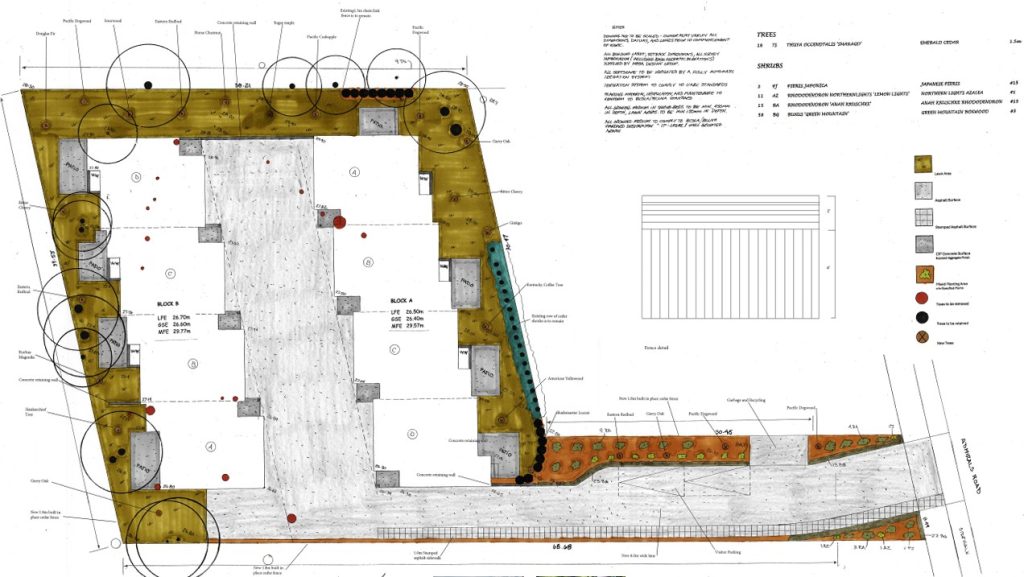
A major concern raised by ECO and the View Royal Climate Coalition (VRCC) is that the current design for 903 Admirals Road does not adequately respond to Esquimalt’s environmental objectives.
Graham Tarling’s June 15 presentation to Committee of the Whole emphasized:
- The rarity of the mature tree canopy on the property.
- The ecological value of retaining large trees rather than relying solely on replacement planting.
- Opportunities to redesign portions of the project to better align with Official Community Plan (OCP) and Development Permit Area (DPA) objectives.
ECO and VRCC initially viewed Bill 16 as a potential tool that could influence the 903 Admirals Road proposal. However, discussions with Engineering staff clarified that the legislation relies on supporting municipal bylaws, and Esquimalt does not currently have sufficient green infrastructure bylaws in place to significantly affect the project. While Bill 16 may shape future development standards, it is unlikely to materially change the outcome of the current application.
Bill 16 Can Require Features, Not Space
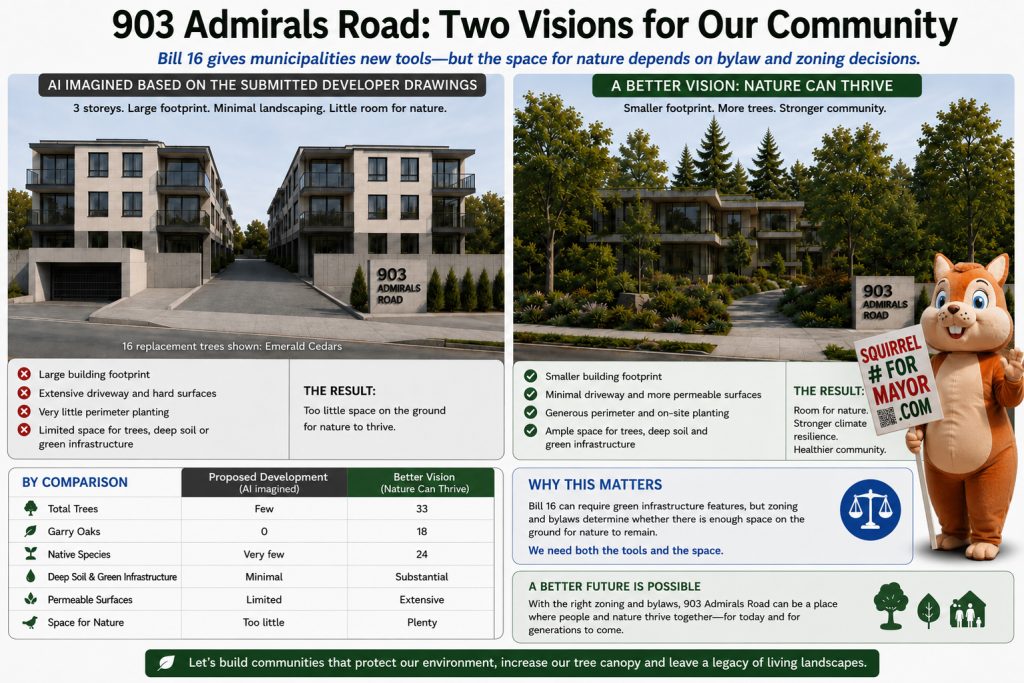
One of the most important insights from the discussion is that Bill 16 can require environmental features, but it cannot create the physical space needed to make those features effective.
A municipality could require:
- Native plantings
- Rain gardens
- Stormwater infiltration systems
- Tree planting
- Green infrastructure elements
However, if zoning permits a building footprint that occupies most of a site, those requirements become increasingly difficult to implement in a meaningful way.
This raises a broader question about the relationship between green infrastructure policies and zoning regulations. Setbacks, lot coverage, building envelopes, and site layout ultimately determine how much land remains available for trees, deep soil areas, and natural stormwater management.
A mature tree requires significantly more space than a replacement sapling. Narrow side yards and fragmented planting strips may accommodate shrubs or small ornamental trees, but they rarely provide sufficient soil volume or root protection areas to retain or establish large canopy trees.
As a result, municipalities can adopt ambitious environmental objectives, but if zoning standards leave little contiguous plantable space on redevelopment sites, the ecological benefits of those objectives may be difficult to achieve.
One example is View Royal’s approach to Small-Scale Multi-Unit Housing (SSMUH). To protect the urban canopy and preserve contiguous soil volume, View Royal’s SSMUH regulations place a strict cap on overall building scale: fourplexes at 372 m² and sixplexes at 558 m². The intent is to keep building footprints compact and preserve permeable land. This allows for an average unit size of approximately 93 m² (1,000 sq. ft.) while maintaining space for trees, stormwater infiltration, and other natural assets. As a social co-benefit, this scale can support a diverse community by providing attainable housing options for young families while allowing seniors to downsize within their neighbourhoods.
This raises an question posed by VRCC member Linda Jeaurond: could progressive municipal standards under Bill 16 – when integrated with basic site regulations – ultimately require a developer to shrink or modify a building footprint to ensure natural assets have the physical space to function safely and effectively?
While Bill 16 cannot be used to prevent development permitted under zoning, it is important to note that provincial Bill 44 does not allow municipalities to restrict the density permitted by their zoning bylaws. If a zoning bylaw allows a certain amount of density, Bill 16 cannot be used to override that entitlement. However, it may allow municipalities to establish non-waivable infrastructure standards that shape how development is accommodated on a site.
A Significant Policy Opening
Perhaps the most significant outcome of the meeting was confirmation that OCP and Development Permit Area guidelines can potentially be translated into enforceable bylaws, provided they are suitable for legislative application.
This distinction is important because OCP policies often express municipal aspirations, while bylaws create legally enforceable requirements.
If Esquimalt proceeds with a green infrastructure bylaw, it could create stronger mechanisms for:
- Tree retention and protection
- Native planting requirements
- Climate adaptation measures
- Stormwater management through natural assets
- Sustainable site design
However, achieving these goals may ultimately require alignment between servicing bylaws, development permit guidelines, tree protection regulations, and zoning standards. Green infrastructure performs best when sufficient land is reserved for it from the outset.
Why This Discussion Matters
Across the region, municipalities are struggling to balance housing growth, infrastructure costs, climate resilience, and biodiversity loss.
The 903 Admirals Road discussion demonstrates that Bill 16 may provide municipalities with a practical pathway toward enforceable standards that integrate natural assets into development.
For advocates concerned about mature trees and urban ecosystems, the meeting suggests that Esquimalt engineering staff are not dismissing green infrastructure approaches. Rather, they are exploring how these tools could be incorporated into future bylaws in a manner that is fair, technically feasible, and legally enforceable.
The result is not an immediate victory for tree retention at 903 Admirals Road, but it may represent the beginning of a broader conversation about how the region can use Bill 16 to embed climate resilience and natural asset management directly into its development framework.
The remaining question is whether future environmental requirements will be matched by zoning standards that preserve enough space on development sites to make those requirements successful. Bill 16 can require green infrastructure, but zoning ultimately determines whether there is room on the ground for nature to remain.
Resources
Tarling, G. (2026, June 15). Presentation to the Committee of the Whole regarding 903 Admirals Road on behalf of Esquimalt Climate Organizers (ECO). Township of Esquimalt Committee of the Whole Meeting. Presentation begins approximately 16:25. Available at:
Township of Esquimalt Committee of the Whole Meeting Video (June 15, 2026)
https://garryoakecosystem.com/2026/03/demand-more-garry-oaks-and-their-ecosystem-are-saved-on-this-admirals-road-development/