ART · ECOLOGY · CIVIC LIFE
The best cities think in acorns, not election cycles.
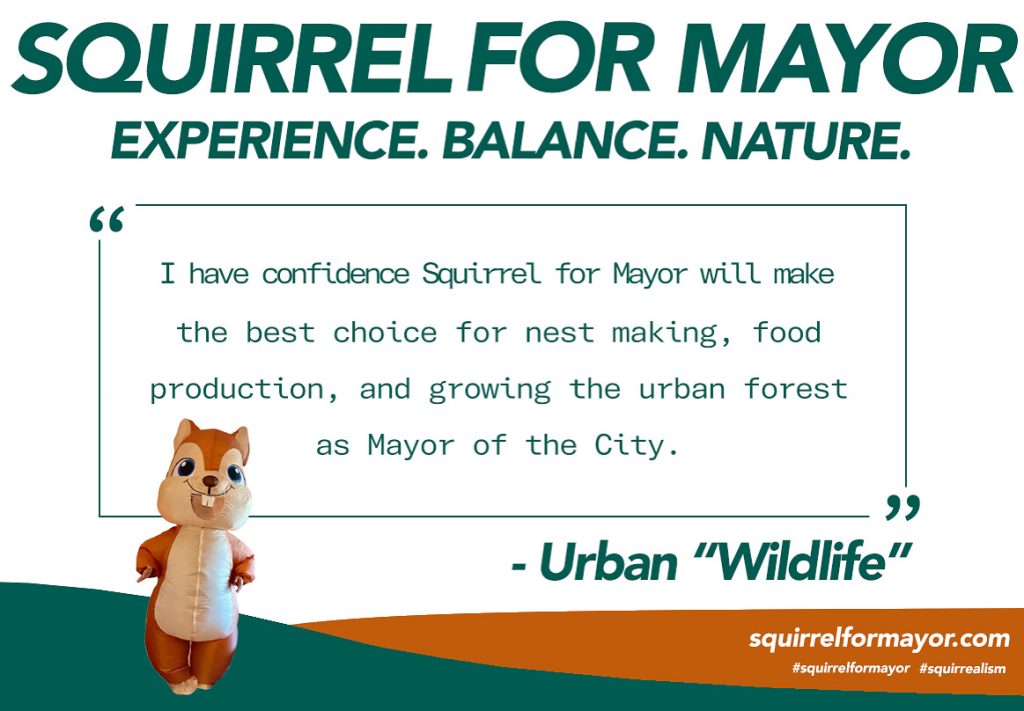
Squirrel for Mayor brings art, research, and a touch of humour to the decisions shaping our neighbourhoods. How can we make room for housing, healthy urban forests, and the many species that call the city home?
An artist-led, non-partisan research-creation project—not an election campaign.
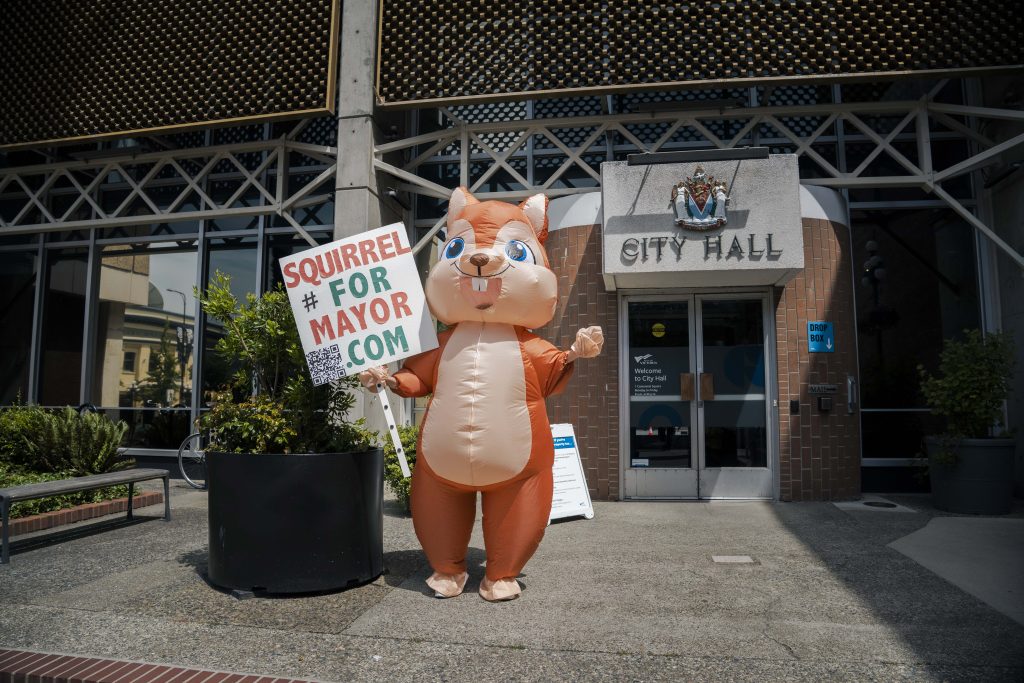
A different perspective on city life
Squirrel for Mayor combines arts-based methods, policy research, and community engagement to explore urban forest health and public participation in local decision-making.
Rather than treating housing and environmental protection as competing priorities, the project asks how planning can support both. It invites informed discussion, practical ideas, and long-term thinking about the places we share.
Trees & habitat
Making space for mature trees, biodiversity, and connected habitats in a changing urban landscape.
Housing & place
Exploring how homes, transportation, public spaces, and ecological health can be planned together.
People & participation
Examining whose voices shape local decisions—and how communities can participate meaningfully.
A squirrel enters the conversation
Watch Squirrel for Mayor: Public Participation in Urban Forest Governance to explore the project in action.
Urban Forest Governance
British Columbia currently has no legislation specifically protecting urban forests. Recent provincial housing legislation—including Bills 44, 46 and 47 (2023), Bill 18 (2024), and Bills 13, 14 and 15 (2025)—has significantly changed local land-use planning by limiting public hearings and reducing opportunities for community input on many development decisions.
In many cases, decisions that affect mature trees and neighbourhood liveability are now made administratively, while municipalities often lack the environmental inventories and ecological mapping needed to fully assess cumulative impacts.
Urban forests are essential infrastructure
Mature trees intercept stormwater, reduce flooding, cool neighbourhoods, improve air quality, and provide habitat for wildlife. These benefits cannot be quickly replaced, as newly planted trees require decades to develop equivalent canopy and ecological value.
Protecting urban forests therefore requires planning that considers soil volume, root space, setbacks, and long-term canopy retention—not simply tree replacement.
Trees on private land
Most urban forests are located on private land, making development policy especially important. For example, approximately 75% of the City of Victoria’s urban forest, 72% of Saanich’s urban forest, and 42% of Oak Bay’s 33% city-wide tree canopy occur on private property.
As land-use regulations continue to evolve, there is a growing need for transparent governance, evidence-based planning, and stronger consideration of urban forests as critical natural infrastructure.
Where is this project located?
This website shares content related to urban forest management of Čaŋēɫč (lək̓ʷəŋən) or ĆEṈ¸IȽĆ (SENĆOŦEN) or p’hwulhp (HUL’Q’UMI’NUM’) also known as Garry oak (scientific name: Quercus garryana) and the associated ecosystem (Kwetlal or ḰȽO,EL). This includes native and non native species as outlined in municipal urban forest master plans.
Starting with data from the lək̓ʷəŋən territory, known today as the Songhees and Kosapsom Nations and we will soon add data from the W̱ SÁNEĆ region encompassing the five local communities: BO,ḰE,ĆEN (Pauquachin), MÁLEXEȽ (Malahat), W̱ JOȽEȽP (Tsartlip), W̱ ,SIKEM (Tseycum), and S,ȾAUTW̱ (Tsawout).