While having lunch with a longtime friend recently, our conversation turned to housing. He had just finished reading Gregor Craigie’s book and, before long, we were discussing density, zoning, and the future of our cities.
Then he asked me something that stopped me for a moment.
“Urban forest is kind of an oxymoron, isn’t it?”
It wasn’t meant to be provocative. It was simply an honest question. But it captured something I’ve been noticing for a long time.
Somewhere along the way, we’ve begun talking ourselves out of urban ecology.
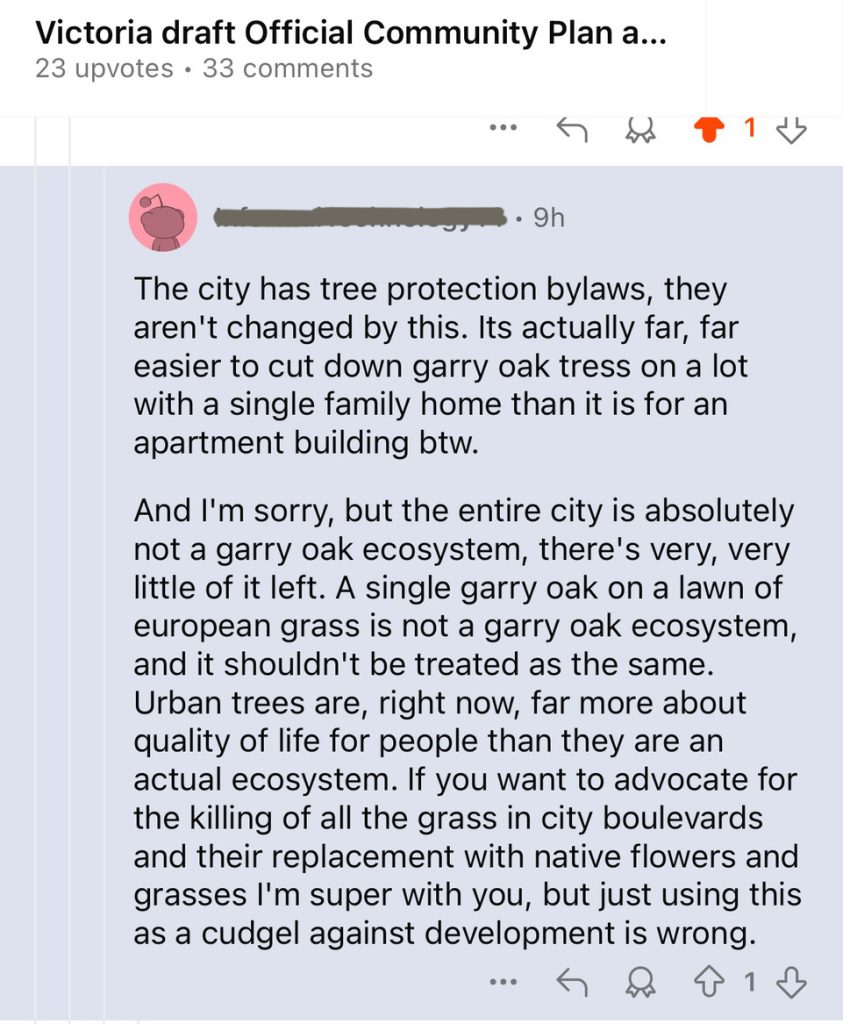
When conversations about housing and development arise, we rarely discuss what ecological functions are actually being lost. Instead, the discussion shifts to entirely different arguments. Cities have to change. Most Garry oak ecosystems are already gone. A single Garry oak isn’t an ecosystem. Canada has billions of trees. Each statement moves the conversation away from ecology.
Take the claim that Canada has nearly 9,000 trees per person. While statistically true, it tells us almost nothing about neighbourhood-scale ecology. Those trees are largely found in remote boreal forests, not in Victoria’s streets, parks, or backyards. Using a national average to justify removing local trees is like saying Canada has plenty of freshwater, so draining a neighbourhood wetland doesn’t matter.
Another common argument is that Garry oak ecosystems were mostly destroyed long ago. Garry oaks were taken down to build your house. It suggests that because environmental colonialism is ongoing, it gives urbanists permission to imagine a future that doesn’t require restitution, repair, or recovery.
We’ve also seen people argue that a single Garry oak growing in a lawn isn’t really an ecosystem. Strictly speaking, it isn’t an intact Garry oak meadow. But mature trees don’t stop functioning because the landscape around them has changed. They still provide habitat, moderate temperatures, intercept stormwater, store carbon, and connect fragmented wildlife corridors. Ecology exists on a continuum, not as an all-or-nothing condition.
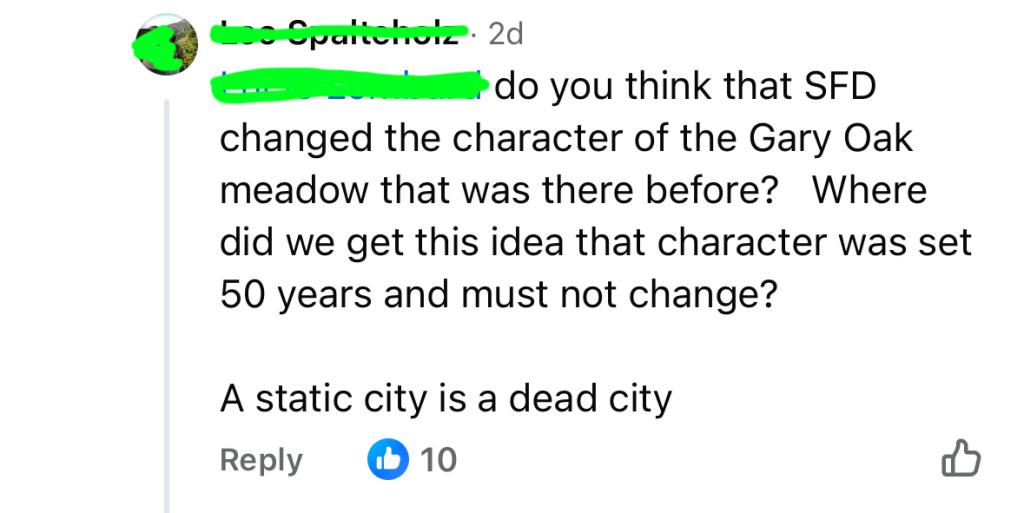
The same pattern appears whenever people dismiss concerns about neighbourhood “character.” Ironically, that language comes directly from municipal policy. Official Community Plans and neighbourhood plans routinely refer to protecting neighbourhood character. Yet when many residents use that word, they aren’t talking only about architecture. They’re talking about birdsong, shade, biodiversity, and the feeling of living among mature trees. They’re describing ecological experience.
One recent comment concluded, “A static city is a dead city.”
Cities should evolve. Housing needs to change, and neighbourhoods will continue to change with it. But ecosystems have limits. The real question isn’t whether cities should change—it’s whether they can change without treating the ecological systems that make those cities livable as expendable.