
By Squirrel For Mayor 🐿
One of the most persistent myths surrounding criticism of Bill 44 is that it comes only from people who oppose new housing.
That simply isn’t true.
In a June 1, 2026 letter to Housing and Municipal Affairs Minister Christine Boyle, the Cadboro Bay Residents Association (CBRA) made something very clear: they support the need for more housing and understand why the Province introduced Bill 44.
But they also believe it is time to review its real-world impacts.
Their position echoes an earlier request from the District of Saanich, which asked the Province in September 2025 to launch a review of Bill 44 after seeing its effects on the ground.
The significance of the CBRA letter is not that it rejects housing reform. Instead, it argues that good legislation should be evaluated when unintended consequences begin to emerge.
Housing and Environmental Protection Should Not Be Opposing Goals
The CBRA acknowledges the need for gentle density and small-scale multi-unit housing.
At the same time, they point to an increasingly visible consequence across Saanich: larger building footprints often require the removal of mature trees, and leaves insufficient contiguous plantable space to replacement them on the property.
Once a site is largely covered by buildings, driveways, and hard surfaces, meaningful tree replacement becomes extremely difficult. Municipal replacement requirements may be satisfied elsewhere, but the neighbourhood itself permanently loses mature canopy.
This is a concern Squirrel For Mayor has raised repeatedly.
Urban forests are public infrastructure. They reduce heat, absorb stormwater, store carbon, support biodiversity, improve air quality, and make neighbourhoods more resilient to climate change.
What Happens to Local Planning?
Perhaps the most interesting part of the letter is its discussion of Local Area Plans (LAPs).
For decades, neighbourhoods across British Columbia worked with municipalities to create detailed local plans identifying where growth should occur, how environmental values should be protected, how transportation should function and how neighbourhoods evolve over time – for all species.
In Cadboro Bay, residents spent years working with Saanich to develop a Local Area Plan that was eventually adopted into the Official Community Plan. According to the CBRA, Bill 44 has significantly reduced the practical value of that work.
Housing can now occur in areas that were never identified for increased density, including locations with limited transit access, increasing dependence on automobiles while reducing the influence of locally developed planning. Whether one agrees or disagrees with that outcome, it raises an important question: What role should communities play in shaping the places where they live?
Affordability Still Deserves Honest Evaluation
Bill 44 was introduced to improve housing affordability.
The CBRA questions whether that objective is actually being achieved in established neighbourhoods.
Instead, they suggest the Province should examine who is benefiting economically and whether the legislation is producing the affordability outcomes originally intended.
This Conversation Is Growing
Over the past year, concerns about Bill 44 have increasingly come from planners, residents’ associations, environmental organizations, and even municipalities themselves.
These concerns generally fall into several recurring themes:
- cumulative loss of mature urban tree canopy
- reduced opportunities for public participation
- weakening of neighbourhood planning processes
- infrastructure pressures
- uncertainty about long-term affordability outcomes
Importantly, many of these voices continue to support increased housing supply.
They are asking whether the legislation can better balance housing with environmental stewardship, infrastructure planning, and democratic participation.
A Review Is Not a Reversal
The CBRA is not asking the Province to abandon housing reform.
They are asking government to evaluate whether Bill 44 is producing unintended consequences and whether adjustments are needed.As more municipalities, professional planners, and community organizations call for a review, the conversation appears to be shifting from whether housing reform is needed to how it can be improved.
Resources
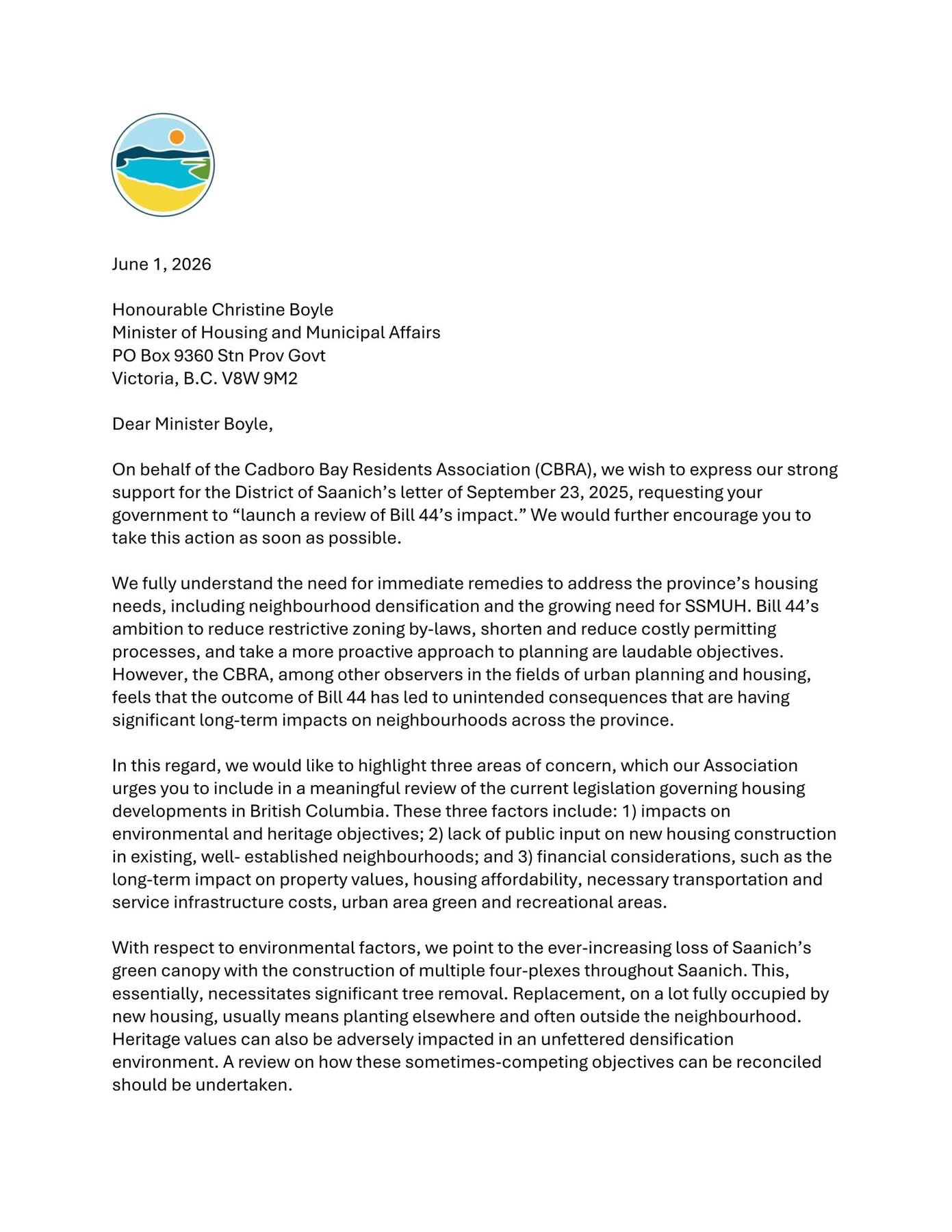
The Cadboro Bay Residents Association (CBRA) represents residents of Cadboro Bay, Ten Mile Point, and Queenswood in Saanich, and has long advocated for thoughtful planning, environmental stewardship, and community engagement.