Article by Squirrel for Mayor 🐿
Saanich is proposing one of the most significant changes to urban tree protection in decades.
Instead of requiring developers to replace removed trees at ratios such as 2:1 or 3:1, the proposed Tree Protection Bylaw would require developments to achieve minimum tree canopy targets. Existing trees would have their canopy measured using GIS mapping, while newly planted trees would be assigned a future canopy value based on their species and mature size. The combined canopy would then be measured as a percentage of the property.
The proposed targets include:
- 35% canopy cover in typical residential neighbourhoods.
- 20% canopy cover in primary growth areas where greater density is expected.
- Up to 48% canopy cover in rural village areas.
This is a significant shift in thinking. Rather than asking, “How many replacement trees were planted?” the question becomes, “Will this site provide enough tree canopy?”
From an ecological perspective, that’s a welcome change. Large trees provide far more cooling, habitat, stormwater interception, and carbon storage than newly planted saplings. Measuring canopy better reflects the ecological function of an urban forest.
However, canopy targets are ultimately constrained by the development envelope.
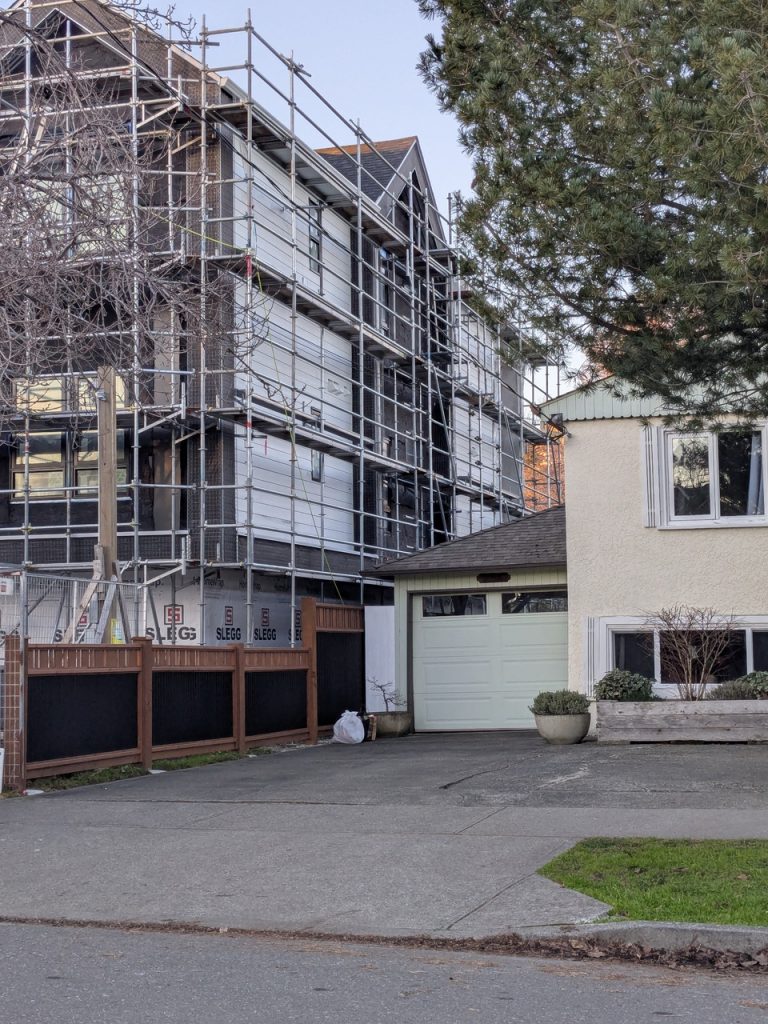
If provincial housing legislation and local zoning permit buildings, driveways, servicing corridors, and reduced setbacks to occupy most of a site, no tree policy can create soil volume where none exists. Future canopy depends on having enough plantable space today.
The proposal also raises several practical questions.
If canopy becomes the new measure of success, how will cash-in-lieu be calculated when a development cannot meet its canopy target? Will Saanich assign a dollar value to each square metre of missing canopy, or develop another method for calculating compensation?
And because newly planted trees are assigned an estimated future canopy, how will the municipality verify that canopy is actually achieved? If trees fail, are removed, or never reach their projected size because growing conditions are inadequate, will there be long-term monitoring or enforcement to ensure the promised canopy is eventually delivered?
Measuring canopy could be a meaningful improvement over simply counting replacement trees. But the success of the policy will ultimately depend on whether developments leave enough room for trees to mature—and whether the projected canopy exists not just on paper, but on the landscape. We are simply not seeing enough plantable space in any new developments for this to work in reality.
References
- District of Saanich. Committee of the Whole Agenda – Draft Tree Protection Bylaw Update (June 9, 2026).
https://saanich.ca.granicus.com/GeneratedAgendaViewer.php?view_id=1&event_id=1783 - District of Saanich. Tree Protection Bylaw Project Update – Questions & Answers.
https://www.saanich.ca/assets/Community/Documents/Q%26A-Tree-Bylaw-project-update-June-2026.pdf - Andrew Duffy. Saanich developers to replant trees based on canopy target under new model. Times Colonist, June 10, 2026.
https://www.timescolonist.com/local-news/saanich-developers-to-replant-trees-based-on-canopy-target-under-new-model-12397216 - City of Victoria. Official Community Plan 2050 – Plantable Space Policies.
https://engage.victoria.ca/ocp - Squirrel for Mayor. Why Is Plantable Space an Important Metric?
https://garryoakecosystem.com/2025/07/why-is-plantable-space-an-important-metric/