The Rockland Neighbourhood Association and the Garry Oak Meadow Preservation Society presented at the public hearing for the Official Community Plan Update on September 11, 2025. The hearing took place over the course of four hearing dates, with Mayor and Councillors voting 5 to 3 to approve the new blueprint for the City and its 12 neighbourhoods.
Thursday, September 11, 2025 at 6:30 P.M. – 11:00 P.M. F.1 Official Community Plan 10-Year Update: Official Community Plan Bylaw, Zoning Bylaw 2018 and Zoning Regulation Bylaw Amendments
Presentation by Ryan Senechal, Garry Oak Meadow Preservation Society. (1:20:41 to 1:25:26)
City of Victoria Agenda https://pub-victoria.escribemeetings.com/Meeting.aspx?Id=72025c5f-79f4-4abb-8767-77d1996f4eef&Agenda=Merged&lang=English
Thursday, September 11, 2025 at 6:30 P.M. – 11:00 P.M. F.1 Official Community Plan 10-Year Update: Official Community Plan Bylaw, Zoning Bylaw 2018 and Zoning Regulation Bylaw Amendments Presentation by Carollyne Yardley, Rockland Neighbourhood Association. (1:11:58 to 1:20:32)
City of Victoria Agenda https://pub-victoria.escribemeetings.com/Meeting.aspx?Id=72025c5f-79f4-4abb-8767-77d1996f4eef&Agenda=Merged&lang=English
Transcript – Coming Soon.
Transcript
Dear Mayor Alto and Members of Council,
The Rockland Neighbourhood Land Use Committee is a group of volunteers that assist City of Victoria staff in notifying community members about proposed land use applications in Rockland to foster a stronger sense of local engagement. We are grateful to City staff who educate us on land use regulations, and Council who value us as community partner. We are not an elector organization and support transparency in presenting at public hearings. We have been performing a listening campaign for over a year now, we’ve completed a neighbourhood survey, and will provide community feedback on three main sections of the draft OCP including Tenant Protection, Built Heritage, and the Urban Forest.
ABOUT
Tenants make up 66% of Rockland residents. Our vulnerable seniors, and low-income households, are concentrated along the transit corridors and Priority Growth residential zones (Fort Street and Oak Bay Avenue). Over 75 percent of residents in Rockland live in multi-unit buildings, and we have a relatively low number of single detached houses compared to other neighbourhoods.
Rockland has a long history of converting historic homes into multiplexes, subdivided into apartments that are environmentally sensitive to increasing density while preserving the neighborhoods’ large tree canopy for urban forest animals. Rockland is the lungs of the City, the center of Victoria’s urban forest, and is without a municipal park.
TENANTS
The draft OCP is based on the premise that allowing developers to build market-rate housing can improve housing affordability for everyone. Policy directives that use the language of compassion and care to provide much-needed housing for those in need often only satisfy unit counts and can lead to displaced communities under the guise of renewal. Upzoning can result in demovictions. The theory that increasing high-quality supply will reduce low-quality prices has known limitations. In-migration is known to end a vacancy chain locally.
Therefore, we support the Victoria Tenants Union request to consider a right of first refusal that guarantees displaced tenants an opportunity to return to a unit in the new building with the same number of bedrooms, at their original rent (with standard rent increases), and compensation throughout the displacement period. Unlike Burnaby and Ladysmith, Victoria’s current tenant protections, by comparison, offer much less compensation.
BUILT HERITAGE + CULTURAL HERITAGE
Rockland’s multiplexes incorporate tenancy with heritage architecture, landscapes, and natural areas that have aesthetic, historic, and cultural importance. They stand alongside BC Tourism attractions like Government House, The Art Gallery of Greater Victoria, Langham Court Theatre, Victoria’s Water Tower, and Craigdarroch Castle as draws for tourism businesses that provide walking, running, bus, and cycling tours and who rely on the neighbourhood for this public amenity throughout the year.
Heritage conserving infill as a use is permitted across most of the City, but would only be relevant where a building has heritage value and is considered appropriate for designation. Only a small portion of Rockland would be covered by Heritage Conserving Area requirements. Therefore, we request that City staff assess the significance of Rockland’s shared cultural heritage, built heritage, and natural geography, and engage a qualified heritage consultant to assist or lead the research, confirming the suitability of coverage under HCA requirements.
URBAN FOREST: CITY-WIDE
Vancouver Island is located within the Coastal Douglas-fir biogeoclimatic zone. Human pressure from development, agriculture, and logging make it the most at-risk biogeoclimatic zone in BC. The Kwetlal food system, colonially known as the Garry oak ecosystem, is a subcomponent of this zone and emerged after the glacial retreat around 10,000 years ago. According to the Canadian Forestry Service, the ecosystem is mostly contained to the Metro Victoria area in Canada. The open woodland character resulted from a millennia of Lekwungen agroecological management and is considered to be a living artifact by the Lekwungen speaking people. In the absence of these activities, the landscape would be dominated by closed stands of Douglas-fir and Grand fir.
While you can find relatively intact Garry oak ecosystems in Regional Parks, 75% of Garry oak trees and modified ecosystems are located on what the municipality refers to as private land. The Garry oak tree, a long-lived, keystone species, supports over 1,645 co-evolved species of plants, insects, mammals, amphibians, birds, and reptiles (that differ from wildland species), making its preservation crucial. Garry oak and associated ecosystems in this region have a unique local genetic adaption that would be difficult to re-introduce if lost.
Trees exist on private properties in Victoria that exceed 250 years old, the marker which meets the definition of old growth for coastal forests by the Province of BC, and many of those old trees continue to thrive, vibrating with the rich cultural history of the Lekwungen territory. Naturally adapted to this region to severe droughts and heat, native Garry oak trees serve as vital nature-based solutions to counteract flood risks and the urban heat island effect, particularly affecting vulnerable populations.
Plant ecologist and Indigenous scholar Robin Wall Kimmerer, in her book Braiding Sweetgrass: Indigenous Wisdom, Scientific Knowledge, and the Teachings of Plants, advocates for weaving together Indigenous wisdom and scientific knowledge to help mend the relationship between humans and the natural world.
The City’s OCP Vision 2050 Reconciliation Actions, Understanding Indigenous Land and Water Management states that the City will “seek to understand the practices that have supported ecosystem conservation for millennia and work collaboratively to braid Indigenous knowledge systems with Western science in preserving and enhancing natural assets, and in advancing a climate-forward city.”
The City of Victoria Draft OCP City bylaws, legislation, and process undermine this objective.
- The OCP’s new land use class scheme was determined without a City-wide biodiversity assessment on private land, presenting an obstacle to stewardship opportunities.
- Development Permit Areas for all new housing include requirements for protecting the natural environment, its ecosystem, and biological diversity; however, the General Urban Design guidelines for the urban forest were crafted in the absence of an Indigenous land manager, licensed ecologists, biologists, or urban foresters.
- Tree Protection Bylaw (21-035) has not been updated since provincial housing legislation directives (2022) and cannot provide physical protection for existing trees located within a proposed building envelope.
- We are encouraged that the canopy has grown by 100 soccer fields over 10 years, while adding more than 8,000 net new homes (almost entirely multifamily buildings). However, the rate of growth dropped by 50% in the last four years, meaning 23 hectares short of the previous four years’ urban tree canopy growth rate.
Therefore, we propose the following urban forest policy recommendations:
- Adopt a City-wide Garry oak species detection tool as part of ongoing urban forest remote sensing updates.
- Create an Urban Forest Technical Advisory group as recommended by the City of Victoria’s Urban Forest Master Plan (2012) with representation from Indigenous knowledge systems, environmental organizations, ecologists, biologists, and urban forestry experts to analyze government and third-party data, such as urban forest remote sensing, and report their recommendations to Parks + Urban Forestry.
- The OCP reduced Landscape Area (Plantable space) minimums from 9% to 6% on every development lot. Plantable space is a leading indicator of canopy coverage.
- Therefore, increase the Landscape Area (Plantable space) minimums in Priority Growth and Residential Infill Zoning Areas from 6% to 9%.
- A 6 m backyard setback (for example) provides limited opportunity to retain existing large trees, and the “Minimum Required Trees Per Lot” is excessively difficult to achieve when applying spacing requirements in the Tree Protection Bylaw.
- Therefore, increase all setbacks by a minimum of 2 m for Landscape Area (Plantable space) (i.e., soil area for planting a large species of tree as opposed to a medium size tree) in the Priority Growth and Residential Infill Zoning Areas.
- Update Section (4) Applied Guidelines (Pages 189, 193, etc.) from “INTACT Garry Oak ecosystems” to “and modified Garry Oak ecosystems and Garry oak trees.”
Hay’sxw’qa si’em (Thank you),
The Rockland Neighbourhood Land Use Committee
Resources
Times Colonist, Victoria signs off on controversial new Official Community Plan
September 11, 2025 https://pub-victoria.escribemeetings.com/Meeting.aspx?Id=72025c5f-79f4-4abb-8767-77d1996f4eef&Agenda=Merged&lang=English&Item=8&Tab=attachments
September 15, 2025 https://pub-victoria.escribemeetings.com/Meeting.aspx?Id=ce822df7-5738-4396-89f4-a0ae3b3e72a5&Agenda=Agenda&lang=English
September 18, 2025 https://pub-victoria.escribemeetings.com/Meeting.aspx?Id=d6cd6468-defb-4ed2-a820-7320b9064c6c&Agenda=Agenda&lang=English
October 02, 2025 https://pub-victoria.escribemeetings.com/Meeting.aspx?Id=647da957-ed16-4fdf-9358-cb2643df8eed&Agenda=Agenda&lang=English
The Official Community Plan (OCP) for Victoria has been updated to meet the needs of our growing population and address the housing and climate crises.
What’s Happening
On October 2, 2025 Council adopted a new Official Community Plan: Victoria 2050(External link) after a two year planning process, including a public hearing.
The updated OCP charts a course for Victoria to address current and emerging challenges while honouring and enhancing the city’s unique and historic character. The plan sets the vision and framework to balance growth with preservation and guide the City’s work, decisions and actions over the next three decades.
The changes are part of a citywide process intended to support housing solutions, climate action and complete communities that will shape Victoria through to 2050.
Thank you to everyone who participated in the engagement process. Your feedback shaped how Victoria will grow and change into the future.
To learn more about the OCP update process you can review the core materials Council considered and view past OCP Council sessions.
What’s Happening https://engage.victoria.ca/ocp
This July, Council provided direction to move forward with next steps to update the Official Community Plan (OCP), a long-term planning document that sets out the vision and framework for the City’s development from now to 2050. The City has prepared bylaws for final review this summer and scheduled a public hearing on Thursday, September 11, 2025, 6:30pm for you to have a final say on the OCP update.
The proposed changes are part of a citywide process that may affect all properties and neighbourhoods in Victoria.
Upcoming Public Hearing – Have Your Say
The public hearing on September 11 is your final opportunity to have your voice heard on the proposed OCP update and related zoning modernization.
About the OCP Public Hearing (link to technical docs)
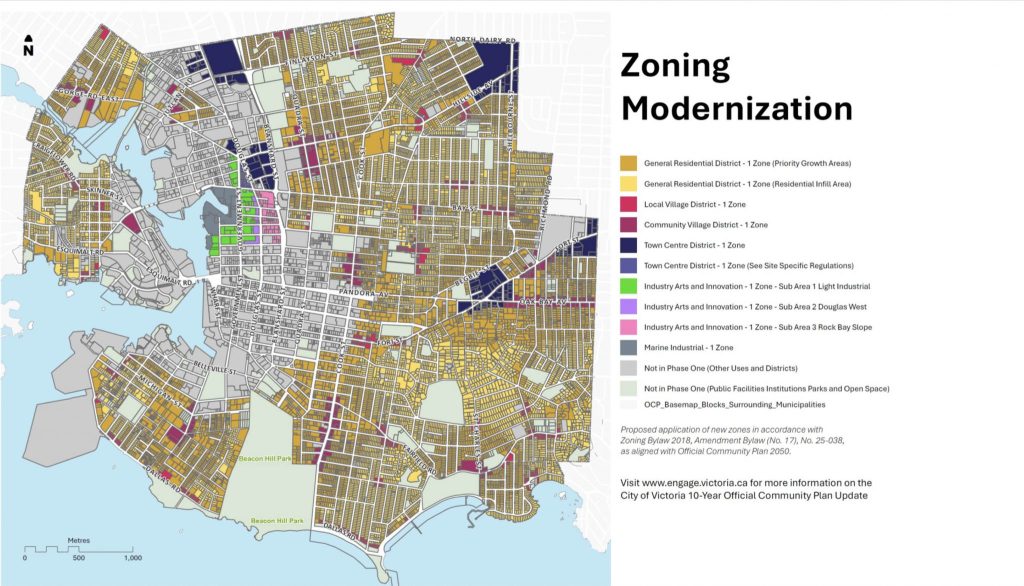
The public hearing will consider replacing Victoria’s current OCP with Victoria 2050 and related bylaw updates that will modernize the City’s zoning.
Once the meeting starts, the live webcast will be available at the following link: https://www.victoria.ca/city-government/mayor-council/council-committee-meetings
What’s at Stake:
Provincial legislation calls for “small-scale multi-family housing of 3 to 4 units” on single-family and duplex lots, depending on size of property in residential areas.
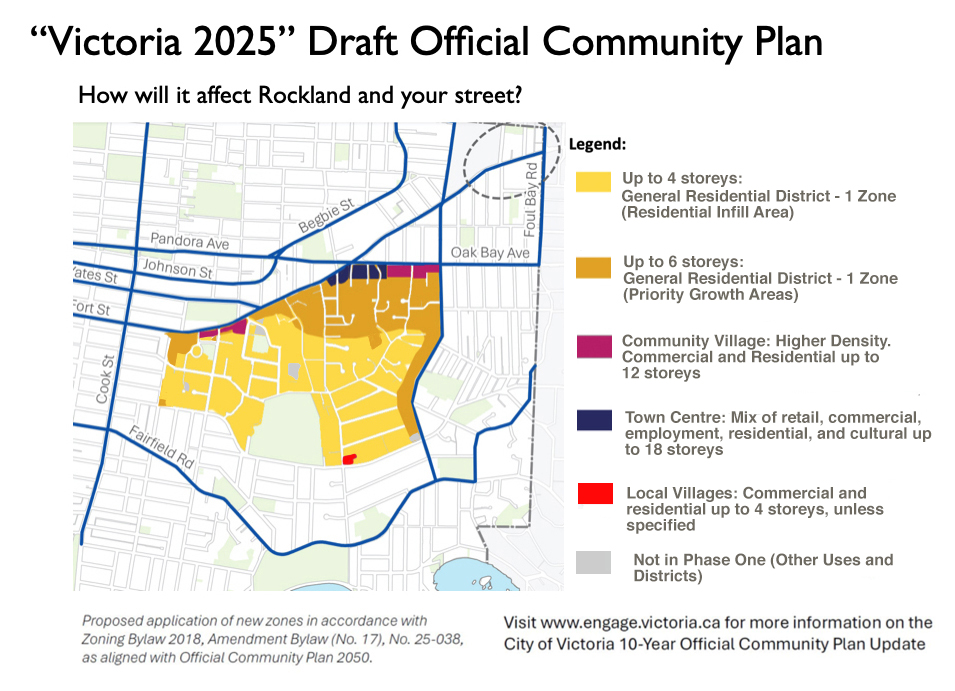
The OCP increases density city-side from units to storeys, including Rockland:
- 4-storeys (light yellow)
- 6-storeys (dark yellow),
- Community villages up to 12 storeys (purple)
- Town Centres up to 18 storeys on Oak Bay Avenue (blue)
- Local villages 4-storeys (red).
- A summary of the zoning modernization changes is available on the City website at https://engage.victoria.ca/ocp.
Includes:
- Reduced setbacks, generally at 4m (front), 1.5m (sides), and 6-8m (backyard).
- Reduced Open Lot Space from 45% to 30%
- Landscape area at 6% of Lot Area
- Block perimeter housing city-wide
About Rockland and City-wide
- 75% of the urban forest, which is the Garry oak ecosystem (GOE), exists on private property in the City of Victoria and is of significant cultural heritage to the Lekwungen people.
- Rockland is epicenter of the urban forest in the City of Victoria: home to many native species that rely on the GOE, for example, Great Horned owl and Cooper’s hawk.
- There has been no mapping and analysis of the overall GOE or individual Garry oak trees on private property City-wide in over 20 years.
- The new land use class scheme was determined without a City-wide biodiversity assessment on private property, presenting an obstacle to stewardship and conservation.
- The tree canopy targets for Priority Growth residential zones (dark yellow) are only 25%, compared to 50% for Residential Infill zones (light yellow). This represents an inequity, for example, greater flood and associated property damage risk and an increased risk of heat-related illness for residents in the Priority Growth residential zone.
- Section 488(1) of the Local Government Act: Form & Character Development Permit Areas (DPAs) for all new housing: Include requirements for a) protecting the natural environment, its ecosystem and biological diversity. However, the General Urban Design guidelines were crafted by the construction industry in the absence of an Indigenous land manager, or licensed ecologists, biologists or foresters.
- Tree Protection Bylaw (21-035) has not been updated since Bill 44, and the Draft OCP, and cannot provide physical protection for existing trees when trees are located within a proposed building envelope.
Urban Forest Policy Recommendations
- To measure progress toward canopy targets, publicize LiDAR vegetation change detection metrics for Zoning Modernization Areas, neighbourhoods, and City-wide, each 4-year period that LiDAR vegetation surveys are updated. Adopt a City-wide Garry oak species detection as part of ongoing urban forest remote sensing updates.
- To ensure that Tree Reserve Funds collected from developments are applied where they are most needed, create an Urban Forest Technical Advisory group with representation from community enviro, non-profit orgs, ecologists, biologists, and urban forestry experts including representatives specialized in urban arboriculture and Garry oak ecosystems. The group will analyze government and third-party data, for example, urban forest remote and report their recommendations to Parks Urban Forestry.
- Large tree species, climate adaptation and public health; a 6 m backyard setback provides limited opportunity to retain existing off property trees near the property line, as well as on property trees outside of the building envelope, and substantially limits soil volume and above ground growing space for large at maturity replacement trees, and makes the “Minimum Required Trees Per Lot” excessively difficult to achieve when spacing requirements in the Tree Protection Bylaw (21-035) are applied, therefore, increase all setbacks by a minimum of 2m for Landscape area/Plantable space (i.e., soil area for planting a large species of tree) in the Priority Growth and Residential Infill Zoning Areas.